

October rolls in and suddenly Halloween isn’t just a holiday — it’s a fun month-long excuse for extreme imagination. Tiny superheroes crawling on all fours. Princesses ruling their castles. Astronauts embarking from the living room. Or maybe that’s just my house with three kids under seven.
Halloween is the perfect reminder of something kids need all year long: space to imagine, pretend, and play.
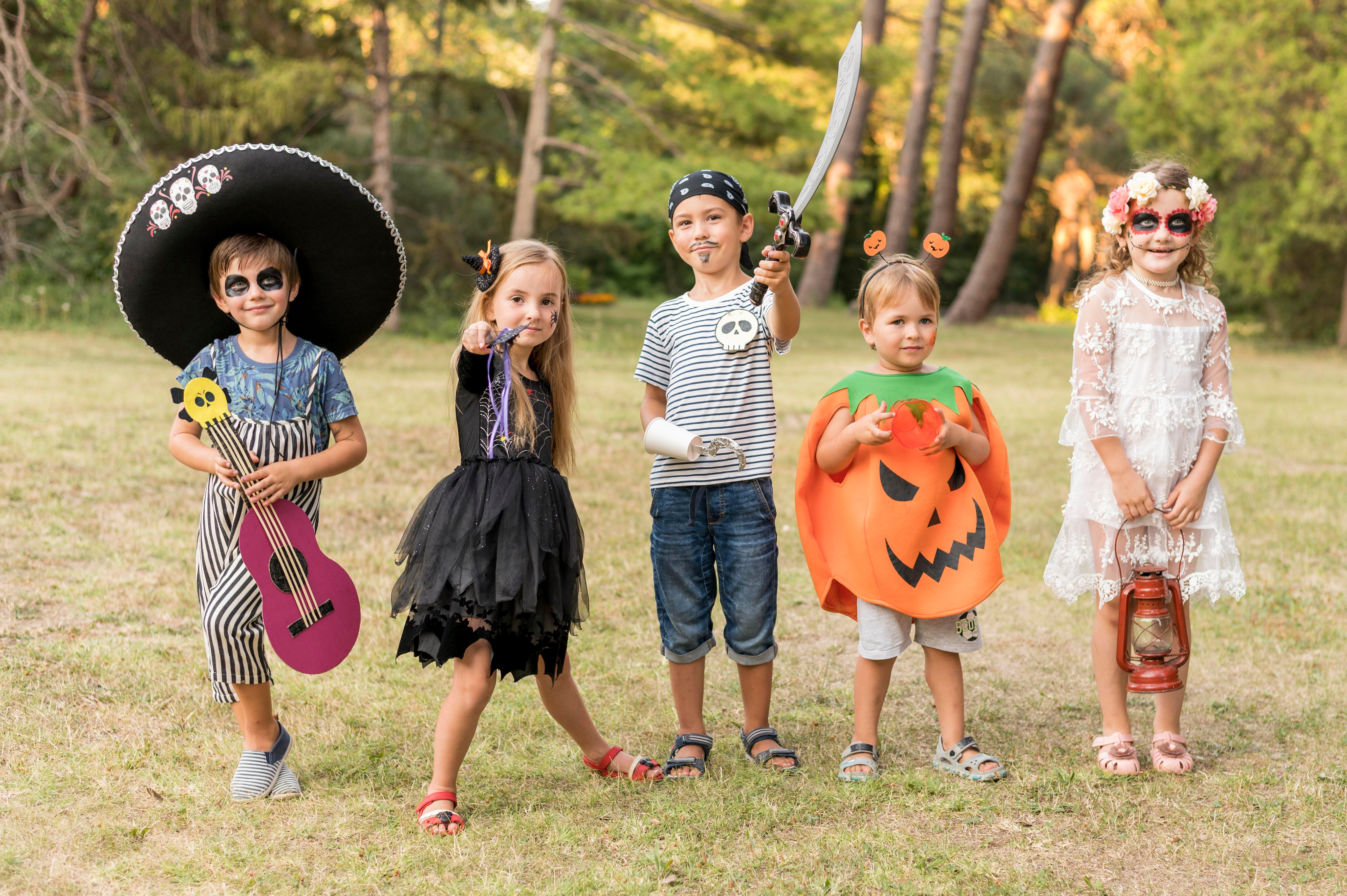
For toddlers through elementary school kids, Halloween isn’t just about candy and costumes. Halloween is a chance to slip into another identity, to play roles, to imagine wildly.
This dress-up and imaginative play that peaks around Halloween is more than adorable. It’s a powerful engine in child development. From toddlerhood through elementary years, pretend play, make-believe, role-playing, and storytelling don’t just entertain — they build thinking skills, emotional strength, social awareness, and more.
Key Concepts
Executive Function: Cognitive skills like working memory (holding information in mind), inhibitory control (resisting impulses), and cognitive flexibility (shifting thinking) that help us plan, focus, and adapt.
Theory of Mind: Understanding that others have thoughts, feelings, desires, or perspectives different from one’s own.
Self-Regulation: The capacity to manage one’s behavior and emotions—recovering from frustration, staying calm, waiting, controlling impulses.
Symbolic / Pretend Play: Using objects, roles, or actions to represent something else (e.g. a box is a spaceship; a child is a pirate), and inventing scenarios or narratives.
Research Spotlight
Free Play & Self-Regulation in Early Childhood: A longitudinal study found that toddlers and preschoolers who had more time for unstructured free play developed stronger self-regulation abilities later on (Colliver et al., 2022)
Pretend Play as Protective Factor for Executive Function: Experimental work (Thibodeau-Nielsen et al., 2020) shows that engaging children in pretend play can improve executive functions (things like working memory, inhibitory control, and flexible thinking).
Pretend Play & Classrooms: Quality Matters: A study of 3- to 6-year-olds found a strong link between the quality of pretend/imaginative play (how engaged children are, how complex the roles are, how “in role” they stay) and their self‐regulation skills. Children who more fully performed the play roles showed higher levels of self-regulation (Bredikyte & Brandisauskiene, 2023)
Social Pretend Play & Peer Relationships: Jaggy et al. (2023) show that social pretend play (this is playing with peers, negotiating roles, collaborating in the story) predicts better social behavior and peer relationships in preschoolers (Jaggy et al., 2023)
Link Between Pretend Play & Social Competence: A recent meta-analysis of studies with children aged ~3-8 found that the more or the better children engage in pretend play, the more social competence (turn-taking, sharing, empathy, cooperation) they tend to have.
Quality of Play & Regulation: Slot et al. (2017) studied preschoolers’ pretend play and found that the quality of their play (how complex the roles were, how deeply they stayed in character) was linked to stronger executive function and emotional self-regulation.
Applications in Play
Here’s how those concepts show up when a child slips into costume or pretends:
Executive Function: When kids invent rules for their game (“pirates can’t touch the floor” or “superheroes only fly in the living room”) and then stick to them, they’re practicing memory, self-control, and flexible thinking if the rules change.
Theory of Mind: A child pretending to be a teacher imagines how a “student” feels when corrected, or a doctor considers how a “patient” might react to a shot.
Self-Regulation: Kids learn to wait their turn for a costume, cope with disappointment if a prop breaks, or calm down enough to stay in character instead of quitting the game.
Symbolic Play: Turning a sheet into a ghost, a broom into a horse, an empty box into a pirate ship are all ways that children build with imagination and make meaning out of simple things.
Why This Matters
Dress-up and imaginative play aren’t just charming distractions: they’re developmental work.
When children slip into another character, whether a superhero, princess, zombie, or chef, they're doing more than having fun. The research shows these playful moments build:
Self-regulation & emotion management. The studies above show that both free and structured pretend play give kids chances to practice managing frustration, delaying impulses, and recovering from momentary mishaps. These are the emotional tools kids need for everyday challenges (e.g., school transitions, peer conflict, or even the inevitable costume zip that gets stuck).
Executive function and cognitive flexibility. Pretend play demands holding multiple ideas in mind (what’s real, what’s pretend), resisting impulses (staying “in story”), and shifting when the story changes. These are the same skills that support following directions, solving problems, understanding reading, and many school tasks.
Social and empathetic growth. When kids negotiate roles, imagine perspectives, or play with others, they learn to understand someone else’s feelings. The peer-play studies show that social pretend play boosts cooperation, empathy, and peer relationships.
Language, creativity, and narrative sense. Pretend stories stretch vocabulary, sequence of events, storytelling structure, which all support reading, writing, and communication.
Lasting benefits & fairness. Importantly, these gains aren’t just for the moment. The longitudinal work (free play → self-regulation later) suggests long-term payoff. And because pretend play doesn’t depend entirely on expensive materials, making sure all children have access helps reduce developmental gaps.
Halloween gives us a vivid example: the thrill of becoming someone else, trying on roles, feeling brave or spooky or silly. If we carry that spirit forward by making space for props and give the kids the time, then we’re investing in the skills kids need for life.
Long Story Short
Pretend play is more than costume fun. It’s practice for self-control, flexible thinking, empathy, language, which are skills that help children thrive in school, with friends, and through life.
Quick Takeaways
Pretend play supports long-term self-regulation.
Playing with peers in a role-play scenario boosts social competence.
Quality and engagement (not just quantity) of play matter a lot.
Imaginative play stretches language, creativity, empathy.
Access to playful time is a fairness issue: making space and props available makes a difference.
Practical Tips for Parents & Educators
Have a simple dress-up box with open-ended props (costumes, hats, fabric, etc.).
Encourage unstructured pretend play time.
Join in sometimes, but follow the child’s lead. Ask questions like “What happens next?” or “How might your character feel?”
Reuse and repurpose Halloween costumes afterward—let them live beyond the holiday.
Observe what kinds of pretend play your child naturally engages in, and encourage the richer/complex ones (with more roles, imagination, story) when possible.
What costume/role did you love pretending to be as a child (or what’s been your child’s favorite)?
Development Decoded is built on a simple belief: science should be clear, practical, and accessible to anyone who cares about kids. I write, research, and create resources outside of my day job and family life to make that happen. If you’d like to help fuel the work, you can now do so with one coffee at a time.
References
Bredikyte, M. & Brandisauskiene, A. (2023). Pretend play as the space for development of self-regulation: Cultural-historical perspective. Frontiers in Psychology, 14. doi:https://doi.org/10.3389/fpsyg.2023.1186512
Colliver, Y., Harrison, L. J., & O’Connor, A. (2022). Free play predicts self-regulation years later: Longitudinal evidence from a large Australian sample of toddlers and preschoolers. Early Childhood Research Quarterly, 59, 235-246. doi:https://doi.org/10.1016/j.ecresq.2021.11.011
Jaggy, A. K., et al. (2023). The impact of social pretend play on preschoolers’ social development: Results of an experimental study. Early Childhood Research Quarterly, 64, 13-25. https://doi.org/10.1016/j.ecresq.2023.02.001
Smits-van der Nat, M., et al. (2024). The value of pretend play for social competence in early childhood: A meta-analysis. Educational Psychology Review, 36(46). doi:https://doi.org/10.1007/s10648-024-09884-Z
Thibodeau-Nielsen, R. B., et al. (2020). Pretend play as a protective factor for developing executive functions among children living in poverty. Cognitive Development, 56. doi:https://doi.org/10.1016/j.cogdev.2020.100964
Slot, P. L., et al. (2017). Preschoolers’ cognitive and emotional self-regulation in pretend play: Relations with executive functions and quality of play. Infant and Child Development, 26(6). https://doi.org/10.1002/icd.2038
Thank you for this post! I knew about the language and cognitive benefits of play, but this really helped me understand the executive functioning and self-regulation benefits!
I’ve had multiple teachers tell me that students are coming into their rooms with less developed self-regulation and executive functioning skills than even a few years ago. I wonder if less imaginative play at home (and more iPads?) could be driving that trend. Any thoughts on if my hunch has any merit?
Thanks for a great post— I will enjoy Halloween all the more for thinking of how it’s impacting young brains! 🎃
There's also something I feel that happens to children when adults join in with them as well during this process of playing creatively. Just look at the fun adults have when putting dinosaur blow up costumes on, or even decorating their homes for halloween. There's something about all of us releasing the inner child as well together which I find powerful when sometimes we forget what it's like to be creative and be silly. That's why halloween is amazing IMO. I see it also for example at festivals only between adults where we create fun totem poles to find our friends, fun outfits we laugh about with strangers on the dance floor. Especially in today's world where we are more self-service, bringing in more play and creativity is a way to break the ice between us when we are older as well.