
Chores Aren’t About Responsibility
How everyday household work supports children’s motivation, helping, and problem-solving

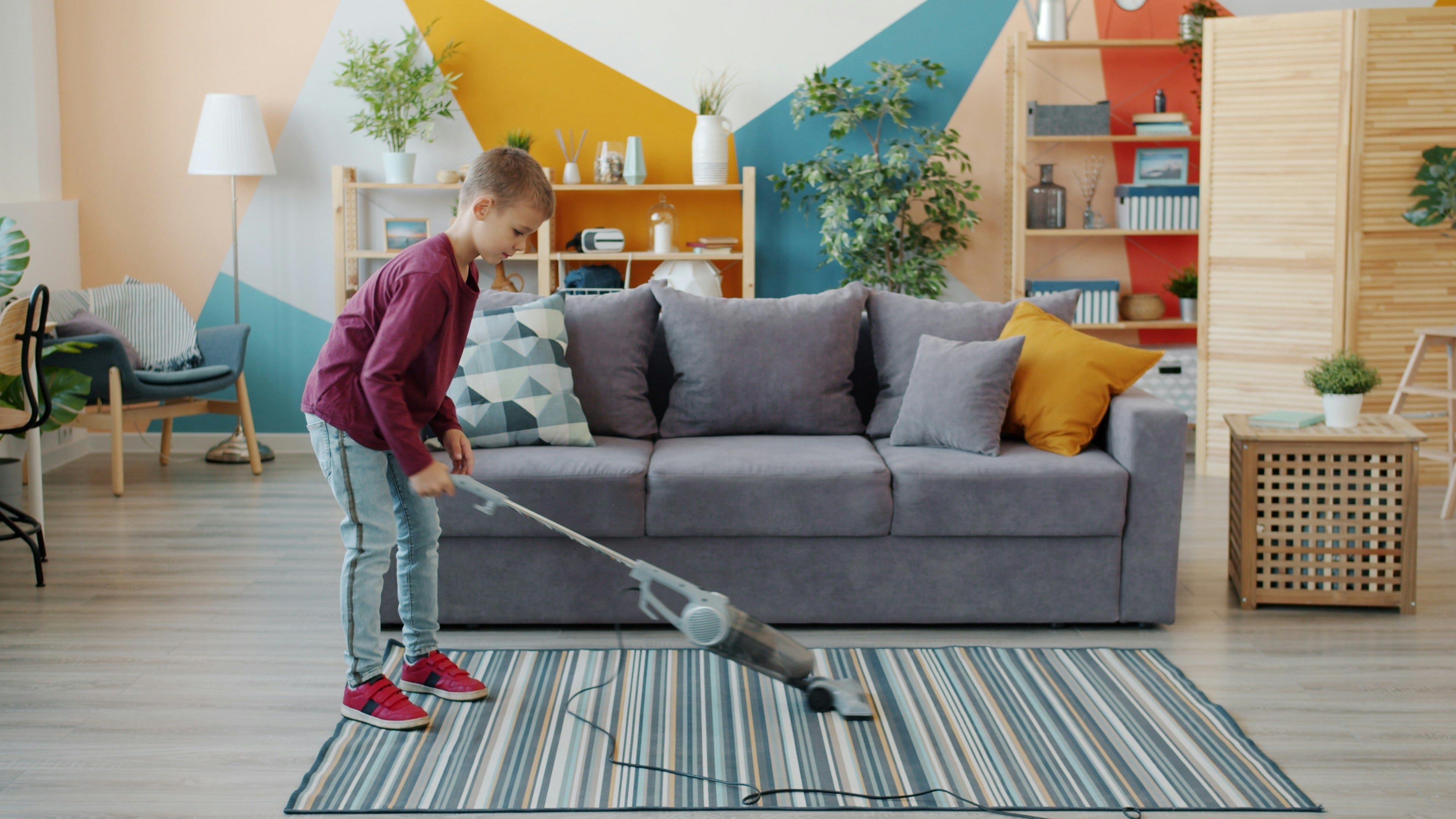
We started listing out chores for our kids (instead of seemingly randomly tell them it’s time to clean up or do laundry, etc.) and it’s changed the way our home functions. Our kids now know what is expected of them on a daily and weekly basis, and we even have a rotating weekly list of chores so no one is stuck with trash duty every single week. This got me thinking that chores are often framed as a parenting litmus tests. Kids should help out or else they’ll grow up entitled, unmotivated, and allergic to effort. You should pay your kids to motivate them. No wait — don’t pay them, they’ll think they should get paid for simply being a part of the family. And on and on the merry-go-round goes.
And all of of these framings miss the point.
From a developmental perspective, chores aren’t about teaching obedience or responsibility in the abstract. They’re about participation: learning how to be part of a shared system, how effort connects to others’ needs, and how competence grows through doing real things alongside real people.
The science doesn’t say “chores = good kids.” It says how children are invited into everyday work matters and that those experiences quietly shape motivation, helping behavior, and autonomy over time.
Research Spotlight
1. Shared chores and early helping (Kärtner et al., 2021)
In a longitudinal lab study following toddlers from 12 to 24 months, parents and children completed everyday tasks together (like folding laundry, putting away books, cleaning up).
The key finding wasn’t that toddlers who did more chores became “better helpers.” It was how parents structured those moments that mattered:
Modeling (showing how to help) predicted increases in helping behavior early on
Praise, when timed after successful effort, supported later increases in helping
Effects were developmentally sensitive, meaning that what worked at 12 months didn’t work the same way at 18 months.
In other words: chores function as a training ground for prosocial behavior when children are supported (not commanded) into participation.
2. Chores, expectations, and everyday family life (Klein et al., 2009)
This ethnographic study took a close look at what children actually do around the house and how that compares to what families think is happening. Across 30 middle-class, dual-earner families, researchers found:
Children contributed far less to household work than parents or children reported
Most children spent very little time helping overall
Allowance was not an effective motivator for increasing participation
Children in families with paid domestic help tended to do fewer chores
What mattered most wasn’t rewards or rules, but clarity and consistency of expectations:
When helping was treated as a normal part of family life, children were more likely to understand their role and participate
When expectations were unclear, inconsistent, or negotiable, participation dropped
Rather than showing that chores “build character,” this study highlights household work as a site of socialization into family roles, responsibility, and obligation or, in some families, a missed opportunity when expectations aren’t clearly communicated or reinforced.
3. Chores and executive function (Tepper et al., 2022)
This paper (n=207 children ages 5-13) examined whether children’s engagement in chores predicted executive functioning.
Greater engagement in self-care chores (e.g., making one’s own meal) and family-care chores (e.g., helping make a meal for others) was associated with stronger working memory and inhibition, even after controlling for age, gender, and disability status.
Pet-care chores were not associated with executive function skills.
The authors argue this likely reflects the cognitive demands built into everyday chores: planning steps, remembering instructions, regulating attention, and shifting between tasks. These findings suggest that routine household work may serve as a form of natural, repeated practice for executive function in daily life.
(Methods note: Because the study is cross-sectional, it can’t determine directionality, meaning children with stronger executive function may also be more likely to be given or take on cognitively demanding chores.)
4. Chores, problem-solving, and parental scaffolding (Xia et al., 2025)
This study looked at whether everyday chores are linked to how preschoolers solve problems, and what role parents play in that process.
In a sample of 4-year-olds, children who were more involved in household chores performed better on problem-solving tasks. That link was strongest when parents used scaffolding (offering guidance early, then gradually stepping back as the child worked through the task).
Findings were that chores worked best as learning opportunities when parents adjusted support rather than hovering or disappearing entirely.
This study highlights chores as a real-life setting where children practice planning, persistence, and flexibility, especially when adults know when to help and when to step back.
Why This Matters
The takeaway isn’t that you need better chore systems. It’s that everyday household work is one of the most developmentally natural ways children learn:
That effort matters
That their actions affect others
That competence grows through participation, not performance
Chores aren’t character lessons. They’re relationship-based experiences.
When we rush, micromanage, or outsource everything children could help with, kids lose access to low-stakes opportunities to practice being capable contributors.
Long Story Short
Chores don’t build responsibility by force. They support responsibility through shared action, developmentally appropriate support, and a sense of belonging.
The question isn’t “Should kids do chores?” It’s “Are they being invited into real participation or just managed?”
Quick Takeaways
Chores work best when they’re shared, not assigned.
Modeling and encouragement matter more than strict rules.
Praise helps, but timing and sincerity matter.
Too much control can interfere with engagement.
Participation teaches more than perfection.
If we want kids who feel capable, helpful, and connected, we need to start by letting them matter in the everyday work of family life, even when it’s slower and messier.
Development Decoded is built on a simple belief: science should be clear, practical, and accessible to anyone who cares about kids. I write, research, and create resources outside of my day job and family life to make that happen. If you’d like to help fuel the work, you can now do so with one coffee at a time.
References
Kärtner, J., Giner Torréns, M., & Schuhmacher, N. (2021). Parental structuring during shared chores and the development of helping across the second year. Social Development, 30(2), 374-395.
Klein, W., Graesch, A. P., & Izquierdo, C. (2009). Children and chores: A mixed‐methods study of children's household work in Los Angeles families. Anthropology of Work Review, 30(3), 98-109.
Tepper, D. L., Howell, T. J., & Bennett, P. C. (2022). Executive functions and household chores: Does engagement in chores predict children's cognition?. Australian Occupational Therapy Journal, 69(5), 585-598.
Xia, L., Chen, S., Hong, X., Liang, Y., Cui, L., & Wu, A. (2025). The relationship between involvement in household chores and problem-solving abilities among preschool children and the moderating role of parental scaffolding. Acta Psychologica, 260, 105629.
I loved this article! I agree that children need to involved in the family with doing chores.
I dislike the word “chores”, most people don’t want to do chores, so I have reframed them with my son for many years as “family cares “. I’ve talked to him and the parents I coach about these “family cares” as a way of taking care of the family and taking part in functioning of a household. At 16 yrs old he’s aware of doing family cares everyday in some way. I let him know his participation and doing these family cares truly matters to me, especially as a single parent and that there’s a purpose to how we work together in a household to take care of our family in this way.
Thank you Laura for this clear and grounding synthesis. What resonated most was your emphasis on participation over performance—it reframes household work as an invitation into belonging rather than a test of character.
One thought your article sparked for me is how modern efficiency culture may unintentionally strip children of these low-stakes learning environments. When speed and convenience dominate, children lose access not just to chores, but to being needed. I wonder how many behavioral struggles stem less from resistance to effort and more from a lack of meaningful contribution.