
Why the First Five Years Matter (Without the Fear-Mongering)
Why early brain development is about building foundations, not sealing fate.

If you’ve ever heard someone say “90% of the brain develops by age five” and felt either panicked or skeptical then you’re not wrong to pause.
The first five years are critically important. But not because childhood is a one-shot window where everything is locked in forever. They matter because this is when the brain is building its basic architecture: wiring systems that later learning, behavior, and emotional health depend on.
Think of it less like pouring concrete and more like laying down the electrical grid of a city. You can renovate later, but early infrastructure shapes what’s easier, harder, or more fragile down the line.
Let’s unpack what’s really happening in those early years, using the science behind images that are commonly found in textbooks (and social media clickbait).
Key Concepts
Synapses: Connections between neurons. More synapses = more potential communication pathways.
Synaptic pruning: The brain’s process of trimming unused or inefficient connections to make networks faster and more specialized.
Myelination: The insulation of neural pathways with myelin, which speeds up communication between brain regions.
Plasticity: The brain’s capacity to change in response to experience. Highest in early childhood, but never zero.
Prefrontal cortex: The brain region involved in planning, impulse control, attention, and complex decision-making. It develops slowly and last.
Research Spotlight: What the Brain Is Actually Doing Early On
One of the most misunderstood facts about early brain development is this:
Early childhood is not about “finishing” the brain. It’s about overbuilding it.
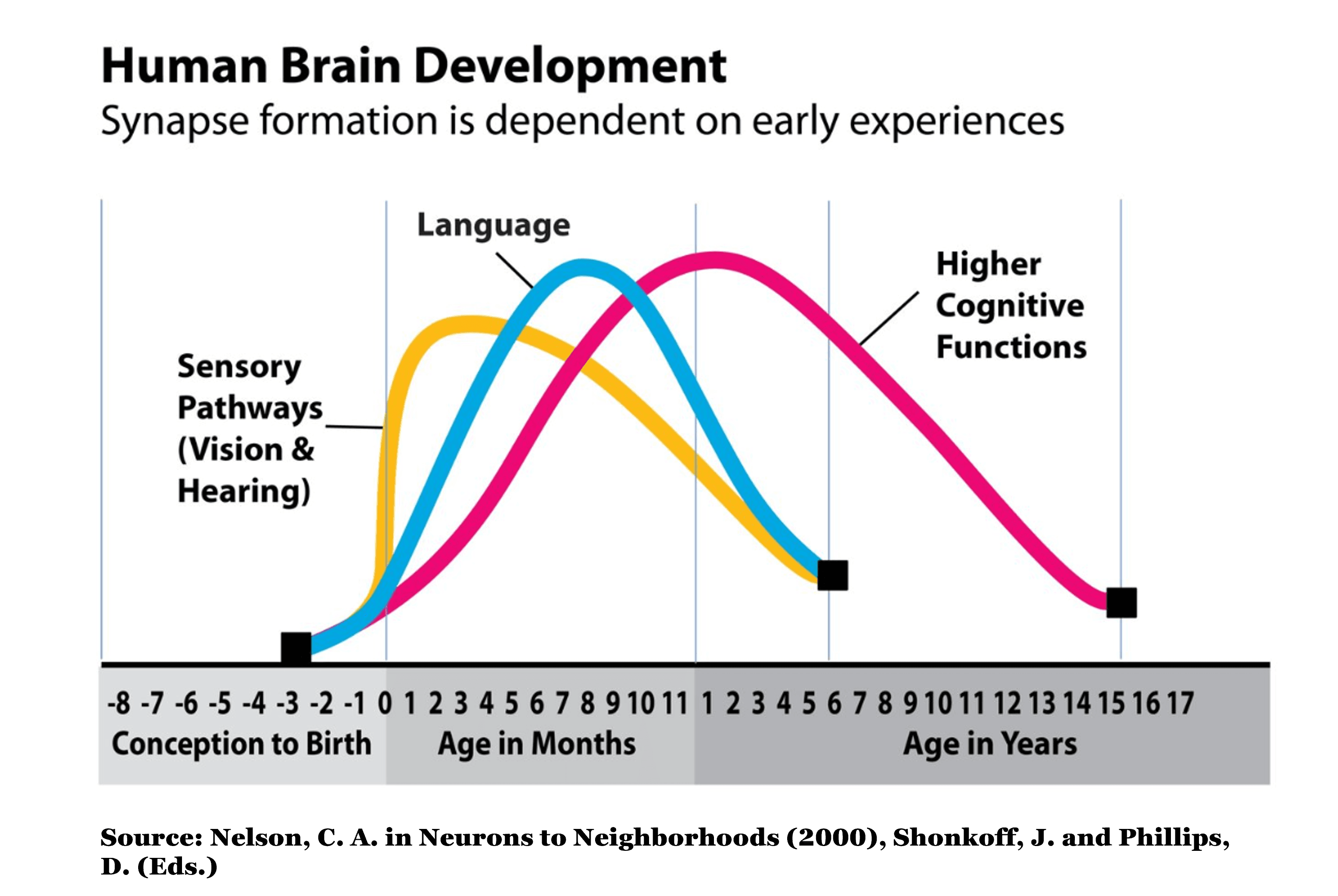
Classic developmental neuroscience work (Thompson, 2001; Thompson & Nelson, 2001) shows that shortly after birth, the brain enters a period of rapid synapse formation, especially in sensory areas (vision, hearing), then language, and later higher-order cognitive systems.
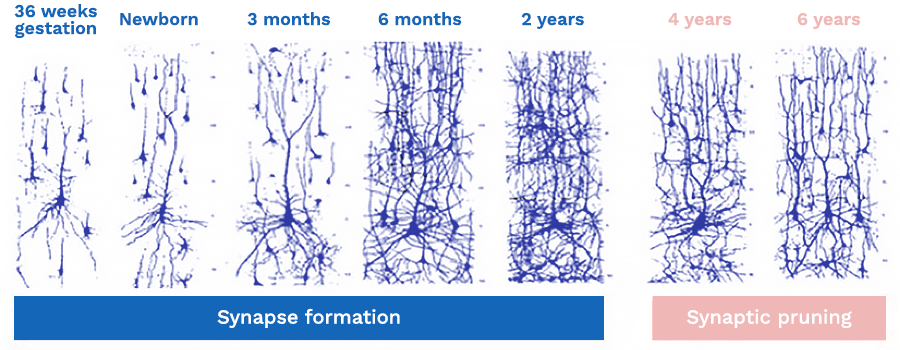
This surge is followed by experience-guided synaptic pruning which simply means that connections that are used repeatedly are strengthened and those that aren’t are eliminated (yes, our brains do use a ‘use it or lose it’ guideline).
Importantly:
Sensory systems peak first (infancy)
Language networks follow (toddlerhood → early childhood)
Prefrontal systems grow and prune over a much longer timeline, extending into adolescence
Myelination follows a similar pattern: fast early gains, continued refinement across childhood, and another acceleration during adolescence, especially in the prefrontal cortex.
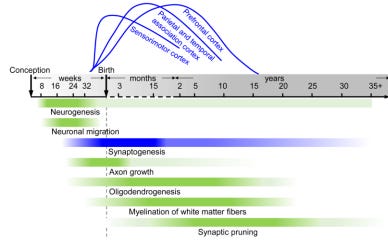
This is why early experiences don’t just teach skills but they actually help decide which neural pathways stay online.
Later work synthesizing neuroscience and developmental psychology reinforces this point: early caregiving, language exposure, and stress regulation shape how efficiently these systems organize, without determining outcomes in a rigid or deterministic way (Miller et al., 2012).
Why This Matters
The takeaway is not that parents must optimize every moment. It is that early childhood environments are biologically influential because the brain is especially open to input.
What matters most during this window:
Reliable relationships (not enrichment products)
Language embedded in interaction, not passive exposure
Manageable stress, buffered by responsive adults
Opportunities to explore, move, and practice self-control gradually
The science consistently shows that ordinary, predictable experiences (e.g., being talked to, soothed, played with, and protected) are exactly what the developing brain expects — these are called experience-expectant processes).
This is also why early adversity can have outsized effects and why supportive interventions later in childhood still work. Plasticity narrows, but it never disappears.
Long Story Short
The first 5 years matter because they’re when the brain is busiest building, testing, and refining its core systems. Early experiences don’t seal a child’s fate, but they do shape how sturdy and flexible the foundation is. Early childhood isn’t destiny. It’s infrastructure.
Quick Takeaways
The brain overproduces connections early, then prunes based on experience.
Sensory and language systems develop before self-control and reasoning.
The prefrontal cortex is nowhere near finished by age five.
Relationships and everyday interactions matter more than “brain-boosting” products.
Early support helps, but growth and change remain possible across development.
Development Decoded is built on a simple belief: science should be clear, practical, and accessible to anyone who cares about kids. I write, research, and create resources outside of my day job and family life to make that happen. If you’d like to help fuel the work, you can now do so with one coffee at a time.
References
Miller, E. K., Maguire, L. K., & Macdonald, G. (2012). Home-based child development interventions for preschool children from socially disadvantaged families. Campbell Systematic Reviews, 1. doi:10.4073/csr.2012.1
Ouyang, M., Dubois, J., Yu, Q., Mukherjee, P., & Huang, H. (2019). Delineation of early brain development from fetuses to infants with diffusion MRI and beyond. Neuroimage, 185, 836-850.
Thompson, R. A. (2001). Development in the first years of life. The Future of Children, 11(1), 20-33. https://doi.org/10.2307/1602807
Thompson, R. A., & Nelson, C. A. (2001). Developmental science and the media: Early brain development. American Psychologist, 56(1), 5.
Hi there, and thank you for the insightful post! I love it and it made me curious to know if this has any connection to childhood amnesia, when and how we develop the category of "nativeness" (like food, language, etc.), the difference in children's memory (very precise but not functionally oriented - remembering exactly the color and shape of the red hat on the sign) and adult's memory (not precise but functional - remembering there's a pizza shop next to the park but nots sure if it was Pizza Hut or Domino's)!
One of my children came to us through international adoption at 2 years and 3 months old. I know this research. But it is still hard to hear.
I have to remind myself that the macro story (broad data) doesn't always apply to the micro (my own family).
And I believe that God is sovereign. That hope helps a lot, too.