
Puberty Is Like a Second Infancy
Why the adolescent brain reorganizes in powerful ways and why early puberty can shape risk-taking and emotional health.

Parents sometimes ask me a version of the same question: Can you tell early on if a child will hit puberty sooner than their peers?
And if they do start puberty earlier, does that mean they’re at higher risk for things like depression, aggression, or risky behavior?
These are good questions! Researchers have been studying pubertal timing for decades because puberty isn’t just a physical milestone. It’s one of the largest developmental transitions between early childhood and adulthood.
In many ways, puberty functions a little like another infancy — a period when the brain reorganizes rapidly, emotions intensify, and social awareness expands almost overnight.
In the first few years of life, infants experience explosive brain growth, rapid learning, and big swings in emotional development. See here for more information on that:

Puberty is another window where the brain reorganizes in powerful ways, especially in regions involved in emotion, reward sensitivity, and social awareness.
But here’s the tricky part: while puberty changes a lot, predicting exactly when it will start is difficult. It is difficult to predict a biological event from social cues, so while there are studies on this, we tend to focus on how the biological event affects the social and emotional health of the child. Let’s dive in!
Key Concepts
Pubertal timing: When a child begins puberty compared to peers (early, on-time, or late).
Pubertal tempo: How quickly puberty progresses once it begins.
Internalizing symptoms: Emotional struggles directed inward (anxiety, sadness, withdrawal).
Externalizing symptoms: Behaviors directed outward (aggression, rule-breaking, delinquency).
Research Spotlight
Researchers have long wondered whether early childhood behavior can predict when puberty will begin and how the timing of puberty might shape adolescent behavior.
A recent study from the Danish National Birth Cohort (Høst et al., 2026) followed more than 11,000 children from early childhood into adolescence. Parents reported children’s emotional and behavioral functioning at age 7, and researchers tracked pubertal development every six months between ages 11 and 18.
Despite this large sample and detailed measurement, the researchers found no strong evidence that early behavioral problems predicted when puberty began. In other words, a difficult year in elementary school doesn’t mean a child is destined to mature earlier than their peers.
Once puberty begins, however, timing relative to peers can matter. In a longitudinal study of more than 2,500 middle school students in Appalachia (De Geronimo et al., 2026), researchers tracked pubertal development and substance use every six months from sixth through eighth grade.
Boys who matured earlier than their peers were more likely to try alcohol or cannabis sooner. Interestingly, the speed of puberty (pubertal tempo) wasn’t related to substance initiation.
In this sample, the pattern also appeared primarily among boys rather than girls.
These findings align with a broader body of research showing that early pubertal timing can create social and emotional challenges during adolescence. In a meta-analysis I conducted with my graduate advisor, Misaki Natsuaki, we synthesized results from 33 studies including nearly 30,000 adolescents.
Across studies, early puberty was consistently associated with higher levels of externalizing behaviors, such as aggression, delinquency, and rule-breaking. This was true for both boys and girls.
A different pattern emerges when researchers look at internalizing symptoms among girls. Decades of research suggest that girls who mature earlier than their peers may experience higher rates of depression and emotional distress during adolescence.
A seminal study (Mendle et al., 2007) found that early pubertal timing in girls was associated with higher levels of depressive symptoms, particularly when combined with stressful social environments. Researchers have continued to research this and believe this may occur because early-maturing girls often face older social expectations and increased peer scrutiny before their emotional coping systems are fully developed.
Taken together, these studies highlight an important developmental pattern: childhood behavior does not reliably predict when puberty will begin, but once puberty starts, timing relative to peers can shape the challenges adolescents face.
Why This Matters
Puberty is often treated like a biological switch that flips sometime during middle school. But developmentally speaking, it’s much more like a second wave of rapid brain reorganization.
During puberty:
Hormones reshape neural circuits involved in emotion
Sensitivity to peer feedback increases dramatically
Brain systems involved in reward and novelty-seeking become more active
Self-control systems in the prefrontal cortex are still catching up
This developmental mismatch is sometimes called the dual systems model of adolescent brain development.
Laurence Steinberg has describe adolescence as a period when reward systems become highly active before cognitive control systems fully mature. Here’s an example of this:
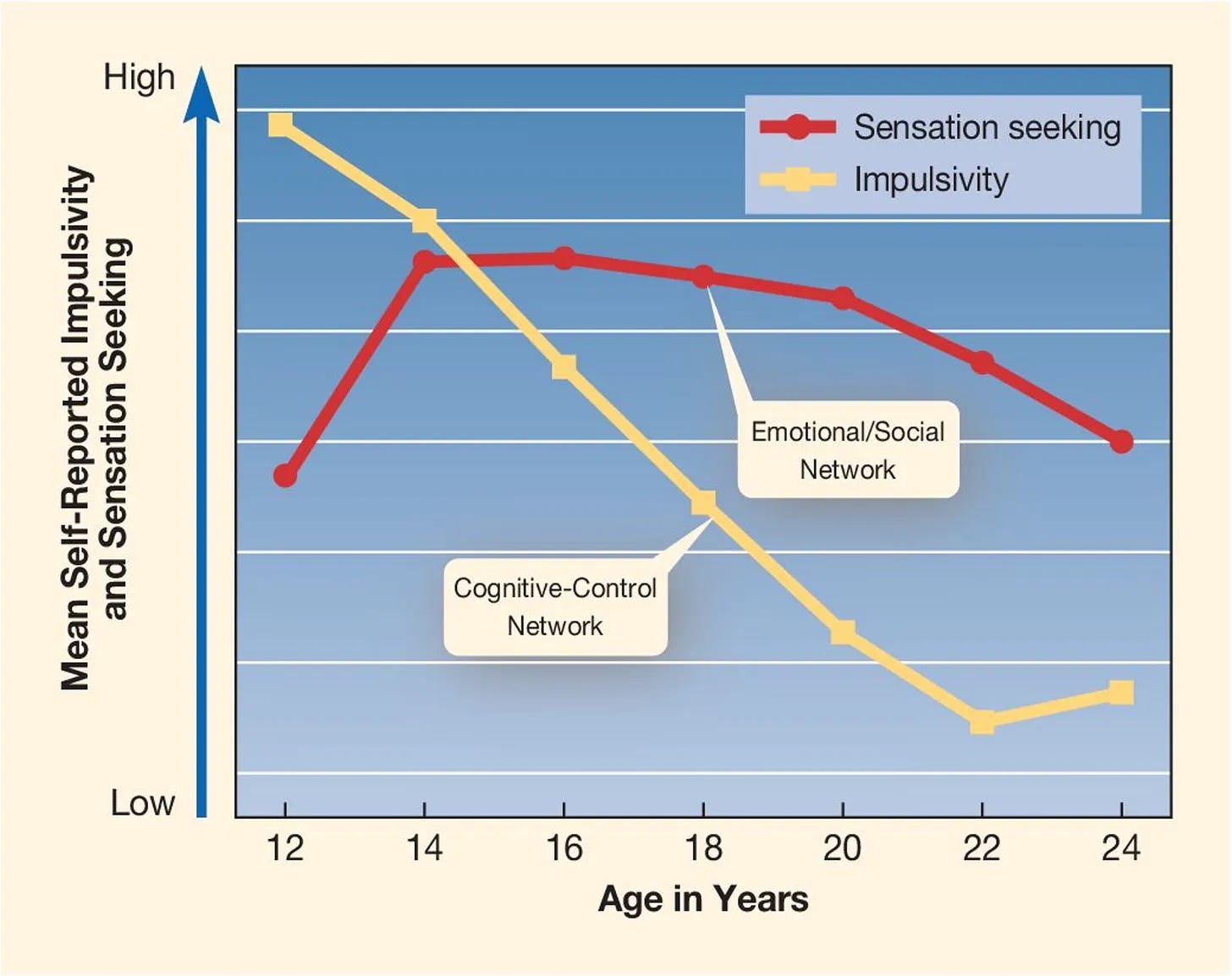
Now add early pubertal timing to that mix. A child who matures earlier than their peers may suddenly:
• look older
• be treated differently by adults
• spend time with older peers
• encounter social pressures earlier
All while their emotional regulation and decision-making systems are still developing. That mismatch can create pressure that sometimes shows up as:
• aggression
• rule-breaking
• earlier experimentation with substances
• emotional distress
Importantly, though, puberty timing is not destiny. Most early-maturing adolescents do just fine, especially when they have strong family support and healthy peer environments.
Parent Lens: What to Watch for if Puberty Starts Early
One of the most important things to remember about puberty is that biological development and emotional development don’t move at the same speed.
A child’s body may begin to look older while their judgment, impulse control, and emotional regulation are still catching up.
This gap is especially noticeable in early-maturing adolescents. Research suggests early-maturing youth may be more likely to:
• spend time with slightly older peer groups
• face social pressures earlier (dating, substances, social status)
• receive expectations from adults that don’t match their emotional maturity
For example, early-maturing girls are sometimes treated as older than they are, while early-maturing boys may suddenly be rewarded socially for risk-taking or dominance behaviors.
None of this means something is “wrong.” It simply means the developmental landscape shifts earlier than expected. Parents can help by focusing on a few protective factors that consistently show up in the research.
Stay connected: Adolescents still need strong parental relationships even when they begin pulling for independence.
Talk about the social side of puberty: Physical changes are only part of the transition. Conversations about friendships, peer pressure, and emotional changes are just as important.
Watch peer environments: Early-maturing kids sometimes drift toward older friend groups. Keeping an eye on peer contexts can make a big difference.
Normalize the intensity of adolescence: The emotional ups and downs of puberty aren’t signs that something has gone wrong - they’re often signs that development is moving forward.
Long Story Short
Once puberty begins, timing relative to peers can shape the social and emotional challenges adolescents face. Early puberty doesn’t guarantee problems, but it can change the developmental landscape kids are navigating.
Quick Takeaways
Puberty is one of the largest developmental transitions after early childhood.
Brain and emotional systems reorganize rapidly during this period.
Childhood behavior does not reliably predict when puberty will begin.
Early pubertal timing is linked to higher risk of externalizing behaviors and earlier substance use in some studies.
Context matters: supportive families and healthy peer environments buffer many risks.
Development Decoded is built on a simple belief: science should be clear, practical, and accessible to anyone who cares about kids. I write, research, and create resources outside of my day job and family life to make that happen. If you’d like to help fuel the work, you can now do so with one coffee at a time.
References
Dimler, L. M., & Natsuaki, M. N. (2015). The effects of pubertal timing on externalizing problems: A meta-analysis. Journal of Adolescence.
https://doi.org/10.1016/j.adolescence.2015.04.006
De Geronimo, F. G., Lilly, C., Kogan, S. M., Brooks-Gunn, J., Kristjansson, A. L., & Allegrante, J. P. (2026). Pubertal Development and the Onset of Substance Use Among Appalachian Youth: A Longitudinal Study. Substance Use & Misuse, 61(1), 87–91. https://doi.org/10.1080/10826084.2025.2546498
Høst, A. P., Ramlau-Hansen, C. H., Strandberg-Larsen, K., Gaml-Sørenson, A. Internalizing and externalizing symptoms and prosocial behavior and pubertal timing in boys and girls: A cohort study. Journal of Affective Disorders, 392, 120179. https://doi.org/10.1016/j.jad.2025.120179
Mendle, J., Turkheimer, E., & Emery, R. E. (2007). Detrimental psychological outcomes associated with early pubertal timing in adolescent girls. Developmental Review, 27(2), 151-171. https://doi.org/10.1016/j.dr.2006.11.001
Steinberg, L. (2010). A dual systems model of adolescent risk-taking. Developmental Psychobiology. https://doi.org/10.1002/dev.20445